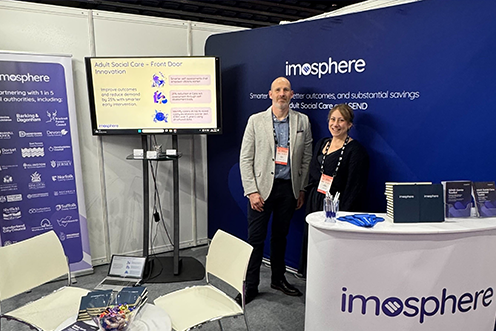
NCASC 2025 Reflections – The sector is shifting. Are we ready to shift with it?
Across three days in Bournemouth, one message kept resurfacing: the future of social care will depend on earlier help, stronger local relationships, and systems that make decisions clearer, fairer and easier to evidence. This year, it was striking how consistent the themes were across children’s services, SEND and adult social care.
What made this year’s conference distinctive was not simply the scale of the challenge, but the sense that the sector is ready to think differently. As long-standing partners to local authorities, we saw alignment between the discussions in Bournemouth and the work many councils are already undertaking to modernise assessment, planning and funding processes.
Below, we share the insights that signal where the sector is heading, and how local authorities can position themselves to lead, not react, to these changes.
Early intervention is becoming the system’s foundation
SEND reform framed early intervention not as an ambition, but as the only viable path forward. With rising EHCP requests, growing tribunal pressures and stretched workforce capacity, reactive models are proving unsustainable. What was notable this year was the shift towards designing for early intervention, not simply advocating it.
This principle echoes what is happening across adult social care. With more than 2 million ASC requests for support last year and spend rising by 8%, councils were clear that prevention is no longer optional. Across our local authority partnerships in adult social care, we’ve supported this shift to a prevention-first model, and seen how this changes outcomes and lives.
Councils increasingly recognise that early help requires more than professional intent. It demands structures that enable practitioners to identify need sooner, reduce duplication, and ensure consistency across teams. Digital tools, shared frameworks, and intelligent workflows are becoming essential to making early intervention real rather than rhetorical.
Across our local authority SEND partnerships, we see how evidence-led assessments, structured workflows and clearer links between need and provision help frontline teams intervene earlier and with greater confidence.
Inclusion requires infrastructure – and co-production at its core
While policy sets the ambition for more inclusive, equitable support, conference discussions focused on the systems and relationships required to deliver it in practice.
Co-production featured prominently, both as a test of authenticity and as a requirement within emerging assurance frameworks. Lived-experience panels, unpaid carers, and community groups were highlighted as essential partners in designing services that genuinely reflect the needs and realities of the people who use them.
Direct payments also surfaced as a key mechanism for inclusion and autonomy. The Minister for Care made clear that DPs and ISFs will be at the heart of a future National Care Service centred on choice and control. Leaders spoke openly about the need for:
- Clearer alignment between needs, outcomes and support
- Transparent and defensible decision-making
- Shared understanding and meaningful involvement
This is where intelligent tools and structured models play a transformative role. They help councils embed inclusion in day-to-day practice by making information easier to interpret, decisions easier to justify, and processes easier to follow. The councils we work with repeatedly highlight the impact of having a framework that supports practitioner judgement – with Connected Funding already helping councils to increase uptake of Direct Payments and help people do the things that matter to them.
Adult social care is entering a redesign era
The statistics shared at NCASC were sobering: more than 2 million requests for support last year, an 8% rise in spend, and a projected funding gap approaching £8.14 billion by 2029. Yet the mood was not one of despair. Instead, there was a clear appetite for redesigning adult social care around prevention, strengths-based practice, and sustainable financial models.
Councils discussed moving toward:
- Early identification through community and digital pathways
- Strengths-based assessments that reduce dependency
- Fair and transparent funding decisions
- Integrated workflows that reduce handoffs and delay
- Real-time data that supports planning and market shaping
This signalled a shift away from describing ASC in terms of crisis and cost, towards framing it around independence, dignity, community and the outcomes people value. Adult social care is looking for connected systems that bring together people, practice, funding, and insight. Our work with authorities on frameworks and systems that bring together people, practice, funding, and insight reflects this shift toward a more cohesive, prevention-first future.
Inspection reform is raising expectations for defensible, traceable decisions
The focus on more inclusive, relational and integrated inspection models means councils must prepare for a future where decision-making is scrutinised more closely than ever. This requires evidence trails that clearly link needs to provision, transparent funding rationales and improved consistency across services.
CQC confirmed:
- Baseline assessments aim to complete by December 2025
- Annual self-assessments and annual meetings will become standard
- Full, rated assessments will occur every 3-4 years
- Unpaid carers and co-production will have increased prominence in evaluations
- Definitions of “good” and “outstanding” will be made clearer and more accessible
Crucially, councils will need to show how decisions were made, what evidence shaped them, and how lived experience informed practice. This raises expectations for defensible, traceable decision-making and stronger internal quality assurance across SEND and social care. Tools that strengthen the golden thread, reduce variation, and improve quality assurance are becoming strategic necessities rather than operational niceties.
One of the strongest cross-cutting themes was the move away from procedural pathways toward relational, whole-life approaches rooted in local neighbourhoods.
Speakers across multiple sessions described systems that work "on paper" but fail relationally, largely because people encounter too many entry points, too many handoffs, and too little continuity.
Neighbourhood models, integrated teams and whole-life planning were presented as essential to:
- Earlier, more personalised help
- Clearer communication with residents
- Better use of local assets
- Continuity across life stages and service boundaries
This aligns closely with the shift towards prevention and with the wider reform ambition to make public services feel connected rather than fragmented.
Looking ahead – building confidence, cohesion and capacity
NCASC 2025 made one thing clear: the next phase of transformation will be defined by systems that connect assessment, planning, funding, and insight into cohesive pathways. Councils that invest in early intervention, inclusion infrastructure, prevention-first adult social care, and safe, purpose-built AI will be best positioned to deliver sustainable, high-quality services in the years ahead.
The sector is ready to shift. The question now is how quickly we can turn that readiness into action – and how effectively we can build the tools, partnerships and processes to support it.